GoHighLevel Voice AI Problems: The 3 Issues Agencies Face
12 min read · Updated July 2026
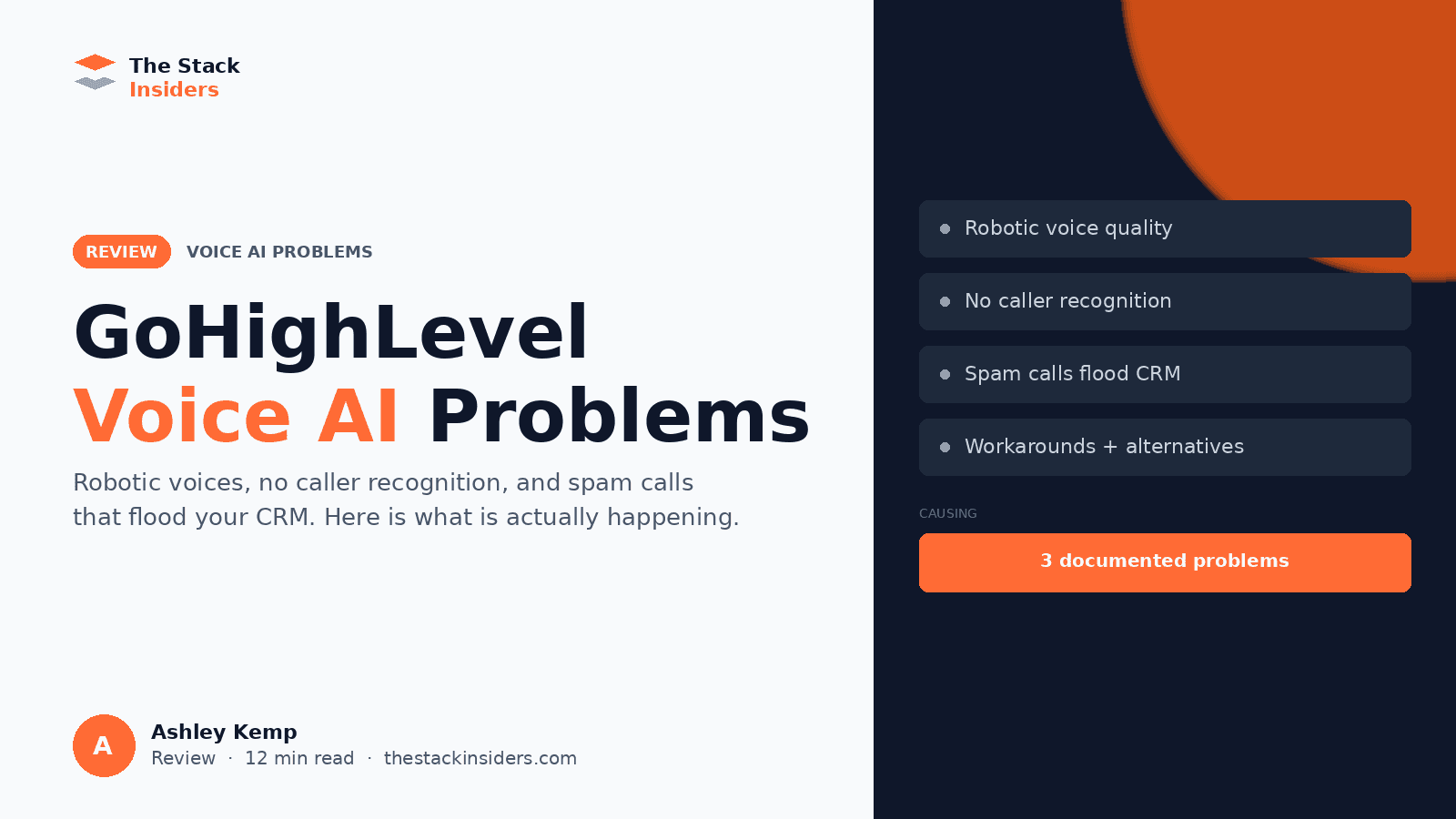
GoHighLevel Voice AI has three high-vote open issues: robotic voice output that drops call quality, no caller recognition so every inbound call starts from scratch, and spam calls that auto-create fake CRM contacts and burn automation credits. Native workarounds are limited; most agencies either configure strict call filters or replace the native agent with a third-party voice AI.
GoHighLevel's own feature-request board at ideas.gohighlevel.com tells a specific story: three Voice AI issues have accumulated 443 combined upvotes, with robotic voice quality at 178, no caller recognition at 174, and spam-call CRM pollution at 91. These are not edge cases from one frustrated user. They represent a sustained, documented pattern from agencies actively running the feature in production. If GoHighLevel Voice AI is not working the way you expected, this breakdown identifies what is actually happening and what options exist right now.
What is GoHighLevel Voice AI?
GoHighLevel Voice AI is a conversational phone agent built directly into the HighLevel platform. It handles inbound calls, qualifies leads, books appointments, and transfers calls to staff without a human picking up. The feature is available on the AI Employee Growth plan at $50 per sub-account per month (which includes 100 Voice AI minutes) and the AI Employee Unlimited plan at $97 per month, which removes the per-minute cap. For a full breakdown of what each tier actually costs, see the GoHighLevel Voice AI cost guide.
Problem 1: Robotic Voice Quality (178 Upvotes)
The most-upvoted Voice AI issue on the GoHighLevel ideas board is voice quality. Agencies report that the AI agent sounds noticeably synthetic, with unnatural cadence and pronunciation that callers immediately recognize as a bot.
What causes it
Voice AI systems convert text to speech using one of several providers. The cheapest options, OpenAI and Cartesia voices, run at $0.015 per minute and produce output that is functional but clearly machine-generated. The premium option, ElevenLabs V3, runs at $0.170 per minute and produces significantly more natural-sounding audio. The gap in realism is audible on real calls. Agencies who defaulted to the budget voice stack without realizing the difference are running calls on voices that were never designed to pass as natural conversation.
What agencies report
The feedback on the ideas board is consistent: callers hang up faster, answer rates drop on outbound sequences, and booking rates underperform against the same workflow run by a human. In appointment-driven businesses where a warm first impression affects conversion, the voice quality degradation is not cosmetic. One pattern that appears repeatedly is agencies discovering the voice issue only after several weeks of live calls, having tested the agent internally on headphones where the synthetic quality is less disqualifying than on a speakerphone in a noisy environment.
What GHL has said
As of the July 2026 date of this post, GoHighLevel has not published a roadmap item specifically addressing the default voice quality gap. The ideas board entry remains open with 178 upvotes and no official status update.
Workaround options
The most direct fix is upgrading the TTS provider inside the Voice AI agent settings. ElevenLabs V3 at $0.170 per minute is substantially more realistic; ElevenLabs V2.5 at $0.035 per minute is a middle ground. The tradeoff is cost: the GoHighLevel Voice AI cost breakdown shows that moving to ElevenLabs V3 pushes the breakeven between pay-per-use and the $97 AI Employee Unlimited plan down to roughly 450 minutes per month, so high-volume accounts should almost always be on the flat plan before upgrading voice quality.
For agencies where voice quality is a hard requirement and the native voices do not meet it, the alternative is replacing the native Voice AI agent with a third-party provider such as Synthflow, VAPI, or Retell AI, connected to GHL via webhook. This preserves the CRM and automation layer while outsourcing the voice synthesis. The tradeoff is integration complexity and a second vendor relationship.
The native voice stack is acceptable when callers already expect an automated system, such as appointment reminders and outbound mass-qualification sequences where the expectation is set before the call.
Problem 2: No Caller Recognition (174 Upvotes)
The second-highest-voted issue on the ideas board is the absence of inbound caller identification. When a known contact calls a GoHighLevel Voice AI number, the agent has no awareness of who that person is. Every inbound call starts from zero, as if the caller is a first-time unknown.
What this means operationally
In a basic qualification flow, the agent asks for name, email, and reason for calling, regardless of whether this caller has been a client for two years. There is no "I see this is Sarah, how can I help you?" moment. The agent cannot reference previous bookings, open opportunities, or past conversations. The Voice AI operates as a standalone greeter rather than a context-aware front desk.
Impact on agencies
The practical effect is a degraded caller experience for existing contacts and leads who have already gone through a qualification process. Agencies running reactivation campaigns or customer service workflows find that repeat callers are treated identically to cold inbound calls. Booking rates on follow-up sequences, where a warm caller expects some continuity, underperform relative to a human receptionist who can see a CRM record. The 174 upvotes on this issue suggest it is one of the features agencies assumed would work at launch and discovered post-deployment did not.
Workaround: webhook pre-fetch flows
The workaround most agencies document is a webhook flow triggered at call start that queries the GHL contact database by phone number and injects relevant contact data into the agent's prompt context before the agent speaks. This requires building a workflow that fires on inbound call events, looks up the contact, and returns key fields to a dynamic prompt template.
The limitation is latency. The lookup and injection need to complete before the agent's first response, which adds a setup step that must be timed carefully to avoid dead air or a slow greeting. It also requires workflow-building effort that adds to agency overhead, and it does not work for numbers that are not already in the CRM. The fundamental issue, that the platform does not natively surface caller identity to the Voice AI agent, remains an open product gap.
Problem 3: Spam Calls Create Fake CRM Contacts (91 Upvotes)
The third documented issue is operationally the most damaging for agencies with tight automation setups. When a robocall or spam call hits a GoHighLevel Voice AI number, the platform's default behavior is to treat the call as a legitimate inbound lead. The result is a loop: spam call arrives, workflow triggers, a contact record is created for the spam number, and automation credits are consumed on a fake lead.
The specific loop
The sequence runs like this. A robocaller or autodialer hits the agency's Voice AI number. The Voice AI picks up and attempts to engage. The workflow tied to the inbound call event fires. Depending on configuration, this may create a contact record under the spam number, add the contact to a pipeline stage, trigger a follow-up SMS or email sequence, and log a Workflow AI execution. Each step that fires consumes credits from the sub-account wallet. A single spam call may trigger several downstream automations before any filter catches it.
This is not a theoretical edge case. The 91 upvotes and the descriptions on the ideas board include agencies reporting dozens of fake contacts created in a single week, credits draining from wallet charges tied to contacts that will never convert, and CRM databases polluted with junk records that skew pipeline reporting.
Workaround options
Several layers of defense reduce but do not eliminate this problem:
Number reputation filtering. Phone number reputation tools flag known spam numbers before the call routes to the Voice AI. Some telephony providers offer this at the carrier layer, stopping the call before it triggers the workflow at all.
Call filter settings inside GHL. GoHighLevel's inbound call settings allow blocking by caller ID, anonymous call rejection, and do-not-call list enforcement. Setting these up correctly stops a subset of robocall traffic, though automated dialers rotate numbers frequently enough that blocklist-based filters are always chasing.
Workflow conditions on contact creation. Gating the contact-creation step with a condition that checks for call duration, a minimum number of speech events, or other quality signals reduces fake records created from hangup-on-answer robocalls, which tend to be very short.
Do-not-contact list imports. Importing known spam-number databases into the DNC list prevents GHL from creating contacts for those numbers even if a call gets through.
None of these fully solve the problem at the platform level. The underlying issue is that GoHighLevel Voice AI does not natively distinguish between a legitimate caller and an automated dialer before firing downstream workflows, and until the platform adds that discrimination, agencies need to layer their own filtering logic.
When GoHighLevel Voice AI Works Well
The problems above are real, but they are not the whole picture. Voice AI performs reliably in specific conditions that agencies can target deliberately.
Appointment reminder calls. Outbound reminder calls to confirmed contacts, where the message is brief and the caller knows what to expect, produce low hang-up rates and clear outcomes. Voice quality expectations are lower for reminders than for sales calls, and there is no caller recognition requirement because the script is not personalized beyond a name and appointment time already in the CRM.
High-volume inbound qualification at scale. When an agency is running a campaign that generates hundreds of inbound inquiries and the conversion rate on those calls does not justify human time at every step, Voice AI cost-per-call math works in its favor. At $0.06 per minute on the budget voice stack, the economics of AI handling first-touch qualification improve as volume scales, even if a percentage of calls underperform versus a human agent.
After-hours coverage. Missed-call scenarios where the alternative is no answer at all are where Voice AI earns its keep. A synthetic voice that captures a lead's information and books a callback is categorically better than a voicemail box. Caller expectations for after-hours contact are different, and the robotic voice issue is less disqualifying when the alternative is silence.
Low-stakes internal triage. Agencies using Voice AI to route calls inside their own operations, rather than as a client-facing first impression, find the quality bar easier to clear.
Alternatives Worth Considering
For agencies where the native Voice AI problems are blocking real deployments, three standalone voice AI providers are commonly used either as add-ons or replacements:
Synthflow connects to GoHighLevel via webhook and offers per-minute pricing with model and voice selection separate from GHL's native stack. Agencies use it when they need finer control over voice quality and call routing logic.
VAPI is a developer-oriented voice AI infrastructure layer with broad model support and low-latency architecture. It requires more technical setup than the native GHL agent but offers more configurability on voice synthesis and call flow logic.
Retell AI positions as a high-realism voice agent with a focus on natural conversation flow. Its latency and interruption handling are frequently cited as advantages over native GHL voice quality.
All three require integration work to connect inbound call events to GHL CRM records, which partially recreates the caller-recognition problem using webhooks. The add-on approach preserves GHL as the CRM while routing voice calls through a higher-quality external engine. The full-replacement approach removes the native agent entirely and treats GHL purely as a contact and automation layer.
The decision between add-on and replace depends on how central voice quality is to the agency's client outcomes and whether the integration overhead is justified by the improvement.
For a deeper look at how GoHighLevel's overall AI pricing interacts with these decisions, the GoHighLevel AI pricing breakdown covers plan structure and when each tier makes financial sense.
FREE TRIAL
Get 30 Days Free With Our Partner Link
- ✓Full access for 30 days
- ✓No charge during the trial
- ✓Cancel any time
Join 2.2 million businesses already running on GoHighLevel
Frequently Asked Questions
Why does GoHighLevel Voice AI sound robotic?
Can GoHighLevel Voice AI recognize returning callers?
Why are spam calls creating contacts in my GoHighLevel CRM?
Is GoHighLevel Voice AI not working, or is it a configuration issue?
Should I use a third-party voice AI instead of GoHighLevel's native agent?
Ashley Kemp is a digital entrepreneur and perpetual traveller. Switched from ClickFunnels to GoHighLevel years ago and never looked back. Writing about what actually works.
Was this article helpful?
Related posts
What a GoHighLevel Voice AI Minute Actually Costs (2026)
10 min read
GoHighLevel AI Pricing Explained: Plans, Rates, Scenarios
10 min read
GoHighLevel AI Employee (2026): Pricing & Setup Guide
12 min read
Is GoHighLevel Worth It? Honest Take After 2 Years (2026)
10 min read
How to Automate Google Review Requests in GoHighLevel
10 min read
Database Reactivation: Win Back Dead Leads in GoHighLevel
10 min read